Visiting the Library to Make a Japanese Keychain for AAIP Month

There is a lot going on right now when it comes to libraries, and as a lover of books and third spaces, I made sure to renew my library card when I moved home. I still had my library card from when I started it in middle school, and it is so old that the system no longer recognizes it. This also gave my sister the opportunity to open her very own library card.
This is a benefit to me, because now I have someone to visit the library with. And we do: she found out that our local library was having an even to craft Japanese Keychains, in honor of Asian American and Pacific Islander Month. So, we made a day out of it and both signed up to go, and that is what I wanted to share today.

Asian American and Pacific Islander Month
I don't remember growing up and having May roll around and having people celebrate me for being Asian American, so I imagine that it is something that has gained more traction from the rise of technology and social media. Apparently, May was chosen to commemorate the immigration of the Japanese to the United States in 1843, as well as the anniversary of the completion of the transcontinental railroad in 1869 (the majority of the workers who laid the tracks were Chinese immigrants).
To me, it is so cool to celebrate my birthday and to maybe expand my knowledge of my heritage and culture. Or maybe the really cool thing is to become more aware of all the different cultures as more awareness is spread as technology and communication continue to evolve. And the beautiful thing about libraries is that they started as great centers for learning and cultural enrichment.

The History of Japanese Keychains
Beyond just being decorative accessories, Japanese cell phone and key chain charms reflect on a person's values, beliefs, and aesthetic sensibilities. Often, Japanese keychains embody a "kawaii" or cute aesthetic that Japan is known for, and are often a testament to the nation's creativity. It's also common to see bags loaded with multiple charms, each one a small decoration of style, fandom, or personal belief.
A majority of shrines and temples across Japan sell omamori, which are amulets or talismans for protections and providers of luck, respectively. The kanji at the heart of omamori means "to guide or protect." Whether or not they work, they are popular in the Japanese culture, especially during the holidays or testing season for students.

How the Japanese Keychain Craft Worked
My sister and I showed up a few minutes late to the auditorium room of our library. There was a table in the center of the room where all of the materials for the craft existed. Long tables filled the rest of the area for us to sit and work on our crafts.
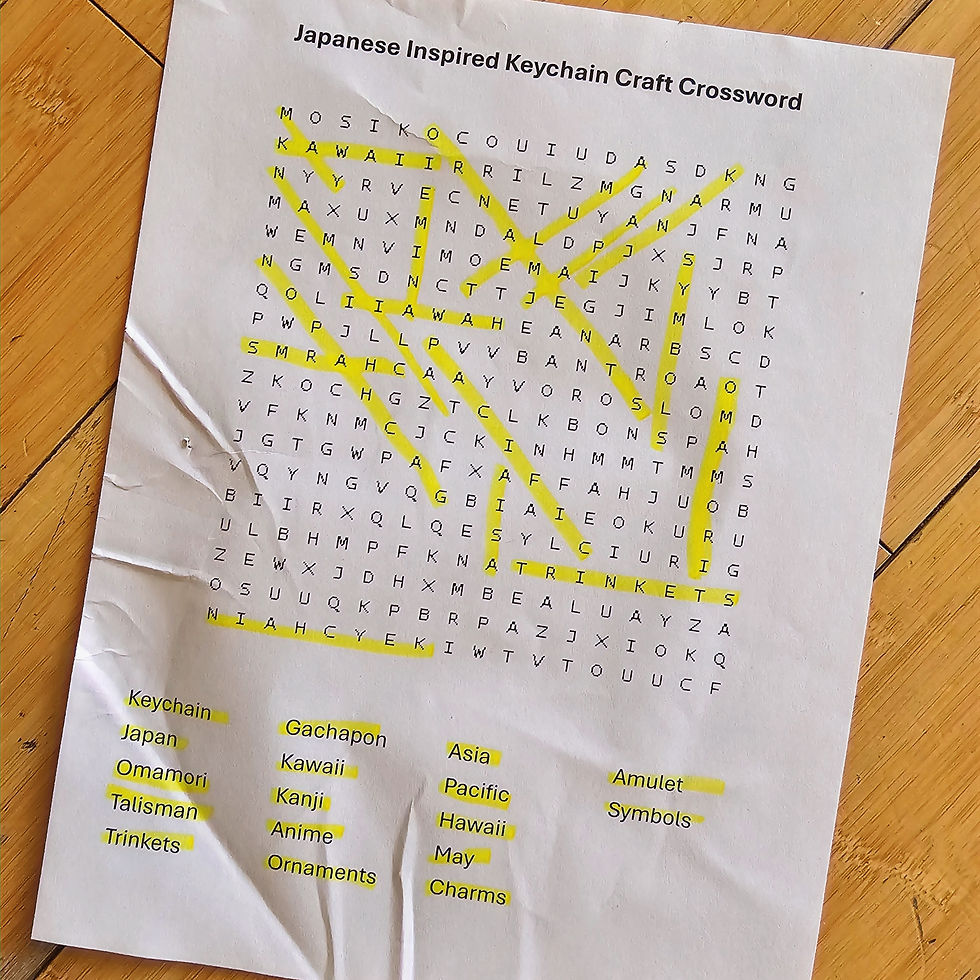
We were given plates to hold our materials on and a "Japanese Inspired Keychain Craft Crossword" to keep us occupied if we had to wait at any point. The plate was useful, because there were plenty of beads that probably would've rolled around and gotten lost without them.
The instructions were that we could use any of the available material to construct our keychains. Once we did that, we should ask for a string to properly assemble our keychains. And so we got to it.
My Process for Developing My Japanese Keychain
Or at least, we waited for other people to finish getting to it. Even though we were a few minutes late, the table with all the materials was surrounded by all of the other event attendees trying to get material, so I let myself complete half of the crossword before I got up to look for materials for my keychain craft.
There were some cute examples, but I had no ideas for what I was going to do for my keychain. After looking over all of the materials, the one thing I was really drawn to was a purple lace flower ribbon, so I picked it up. No one else touched any of the ribbons, so I was the only one having to figure out how to incorporate it into my keychain.
From there, I just picked up things that caught my eye. Unique looking beads, a K for the initial of my name. There was a light blue Mickey Mouse bead that I grabbed, and some colored beads I thought looked nice. And then I arranged them, and this was my result. While it probably isn't perfect, I think the craft really highlights how much I loved this ribbon and wanted to highlight it.

American History that I Wish I Saw
During the 1920s era in the United States, rich people would show off their money by building libraries and funding library initiatives in their names. A prominent example of this is Andrew Carnegie, who built over 1,600 libraries across the US, often in smaller towns and communities. An example of one of these libraries is the Carnegie Library of Atlanta.

How You Can Support Your Local Library
Honestly, I'm not rich, but attending this event was a small way I could support my local library. Using your library card is one way that your library can demonstrate a need for the library's services in order to apply for funding, which will help ensure its continued operation and growth. Since libraries were created with the intent of serving the community, using a library card is one way to show that they are serving their purpose.

Sources:
“Asian Pacific American Heritage Month 2024.” Asian & Pacific American Heritage Month, asianpacificheritage.gov/. Accessed 18 May 2025.
Griffin, Nathan. “Cultural Trinkets: The Charm of Japanese Keychains.” Hello Japan, 10 Apr. 2024, hello-japan.com/blogs/hello-japan-blog/cultural-trinkets-the-charm-of-japanese-keychains.
Jacobsen, Natalie. “A Guide to Omamori: Japanese Lucky Charms.” Tokyo Weekender, 31 Jan. 2024, www.tokyoweekender.com/art_and_culture/japanese-culture/japanese-lucky-charms-the-guide-to-omamori/.
Keyes, Hilary. “Japanese Lucky Charms: A Guide to Omamori for the New Year.” Savvy Tokyo, 30 Dec. 2024, savvytokyo.com/japanese-lucky-charms-a-guide-to-omamori-for-the-new-year/.
Team, Nanika. “The Stories Told by Charms Accessories in Japan.” [NANIKA], 7 Nov. 2024, nanikajapan.com/japan-bag-accessories-charms-keychains-trends/.


Comments